
IN BRIEF
- Student research is a must if your child is interested in the sciences.
- Done well, a student research project does more than help with college admissions.
- By engaging in the scientific process, your child will gain skills that will serve them in college and beyond.
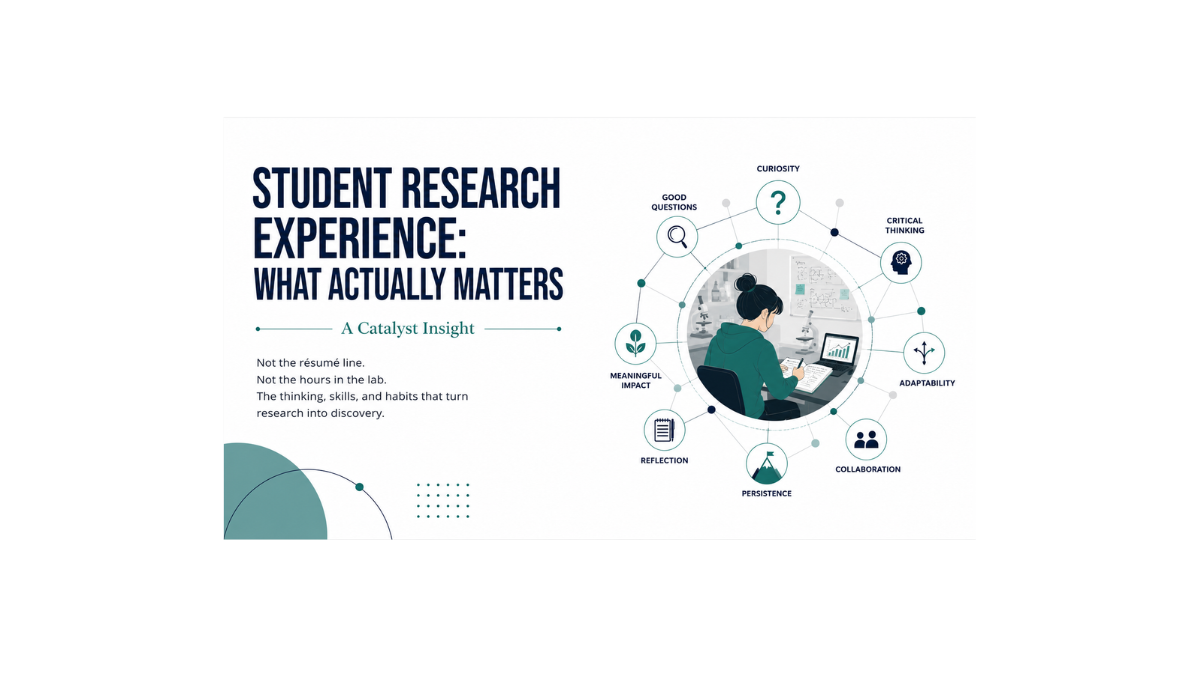
While student research experience is a must-have for any serious science student, parents often assume it’s all about college admissions. And while it can certainly boost a college application, research experience does something bigger; it helps students learn to think like scientists and physicians.
Beyond Admissions: Five Benefits of Student Research
Here are five advantages of a research project that go beyond helping with college admission:
- CRITICAL THINKING – students learn how scientists ask questions, analyze and interpret data, evaluate evidence, and challenge assumptions.
- EXPERIMENTAL DESIGN – students learn how to build experiments, identify variables, use the correct controls, troubleshoot problems, and revise their approach when things don’t go as expected.
- SCIENCE COMMUNICATION – students learn to articulate their ideas, evidence, and data clearly and succinctly through presentations, writing, and discussion with their mentor and others.
- INDEPENDENT THINKING – the research experience should help students develop confidence and ownership of their work, allowing them to make decisions rather than simply follow instructions.
- TANGIBLE OUTCOMES – students learn to work towards producing a meaningful outcome: a product, presentation, publication, and/or entry into science competitions.
Why This Matters for College—and Beyond
Student research isn’t just a college admissions box for your child to check. It is a skill-building opportunity that, done well, will serve them throughout college and well beyond.
As a Stanford volunteer interviewer, I speak with undergraduate hopefuls every year. I can tell the difference between a student who has accumulated activities and a student who has lived their research. It comes out clearly in the conversation. Students who have developed their own research projects generally have stronger communication skills and speak with greater confidence.
Additionally, the skills developed by doing independent research will help your child with their college courses and in securing future internship opportunities. And if your child is interested in the biosciences or considering the pre-med route in college, the skill set developed through an independent research project is gold! It will propel them ahead of many of their peers.
So, yes, a student research project is a must for every student interested in the sciences. However, the benefits are realized only if the project is executed well. Consider seeking help from a mentor, but be careful about “pay-n-play” programs that rob your child of a true independent experience. A mentor helps guide the student while preserving their independence. Whereas paid research programs can become the equivalent of a glorified high school lab, where independence is lost.

Dr. Tobi Schmidt, PhD
Scientist | Mentor | Founder, Bio:Logic
Dr. Tobi Schmidt is a Stanford-trained scientist, mentor, and founder of Bio:Logic, a science mentorship consultancy for students pursuing biology, research, medicine, and the future of the biosciences. Her work focuses on developing scientific thinking, research skills, and AI literacy for the next generation of scientists.