
IN BRIEF
- Strong students can struggle in AP Biology because memorization-based study strategies fail.
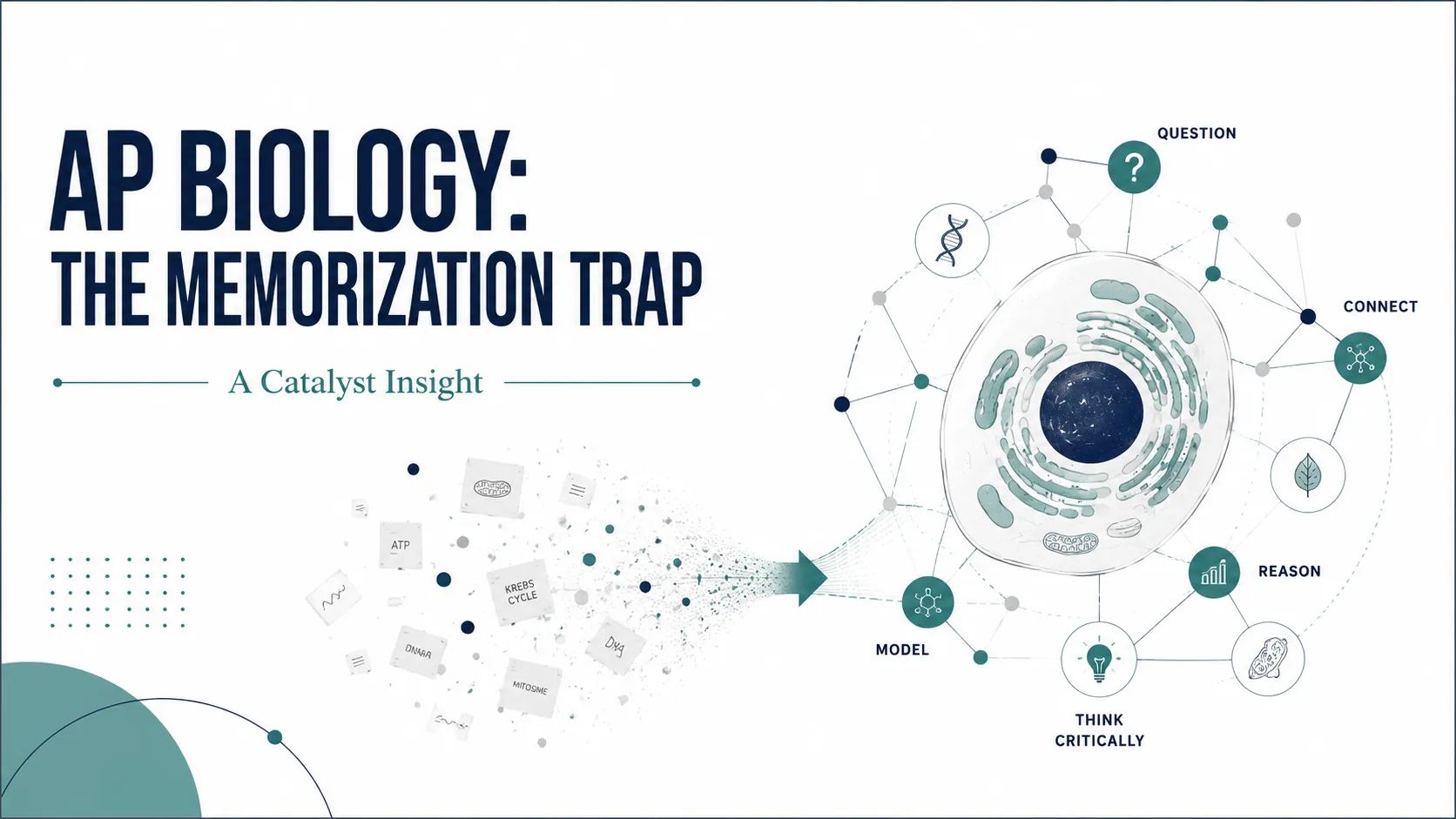
- AP Biology requires students to connect concepts, think in systems, and analyze data.
- Students who move beyond memorization often see dramatic improvements in both grades and confidence.
Strong academic students often struggle in courses like AP Biology. This surprises and concerns parents. They don’t understand how their child can be excelling in nearly every other subject, yet feel stressed, frustrated, and overwhelmed by AP Biology. Parents often watch their child invest real effort and significant time into the course, but their grade doesn’t reflect that effort.
If this sounds like your child, then I have the answer. The strategies that work in other subjects and in an introductory biology course no longer work in AP Biology.
Introductory science and biology classes often reinforce student memorization. Students are supplied with lists of vocabulary words, and concepts are often reduced to simple memorization of associations (e.g., ribosome = protein synthesis). This, however, is not the basis for a foundational understanding in the sciences. This is particularly true of biology.
Early Science Courses Reinforce Memorization
Biology requires critical thinking to analyze conditions and systems thinking to piece together individual concepts to form a complete picture. Biology is not a collection of unrelated facts. Biology is the study of interconnected systems. This adds layers of complexity, and it can be very challenging for both teachers to convey and for students to grasp. And this is why it is often reduced to memorization.
One of the greatest transitions I see is the one students make when moving from introductory biology, or even honors biology, to a course like AP Biology. It is often the first time students are introduced to biology through concepts that no longer rely on memorization. Students are asked to understand the concepts and connect them. Additionally, it may be the first time students have seen real data. The College Board emphasizes the interpretation and analysis of tables, graphs, and statistical significance. So students go from having to memorize names, associations, and intangible concepts like variables and controls to deeper analysis and understanding.
Some students manage this transition better than others. Nearly all students need to make adjustments, but some struggle to do so. This often shows up in poor grades at the beginning of their AP biology course. As a parent, you may observe your student studying for an inordinate amount of time and yet not earning grades proportional to the effort. Students become stressed and frustrated. The problem here is not the student’s ability; it’s their approach. With simple adjustments in how they study, switching from memorization-based studying to one that supports the complexity found in advanced biology classes like AP biology, they can make significant improvements.
Success Requires Rethinking How to Study
This shift away from memorization-based learning is essential, not just for AP Biology, but for any biology or science course going forward. College courses in the sciences are not memorization-based, nor is actually doing science! I could not have engineered immune cells to attack cancer cells had I only memorized my biology. And while I understand that not every student in AP Biology wishes to become a scientist or physician, critical and systems thinking are essential to their success in the course and on the exam. Achieving these goals does not come from more time spent memorizing information. Success comes from learning how to think about the information differently. Students who make this transition see consistent improvements in their understanding and performance. I consistently see students move from Bs and Cs to solid As as they adopt this strategy. Students who don’t find themselves continuing on the path of working harder and harder without significant improvement.

Dr. Tobi Schmidt, PhD
Scientist | Mentor | Founder, Bio:Logic
Dr. Tobi Schmidt is a Stanford-trained scientist, mentor, and founder of Bio:Logic, a science mentorship consultancy for students pursuing biology, research, medicine, and the future of the biosciences. Her work focuses on developing scientific thinking, research skills, and AI literacy for the next generation of scientists.