
Artificial intelligence. I admit that I am fascinated with its potential, and at the same time, I’m deeply concerned about how humans will use it. However, AI is here, and there’s no going back. Our future, and your child’s future, will be shaped by augmented inquiry and AI co-creation. So the deeper, more meaningful question and conversation is not about whether we should have AI or not, or whether we should use AI or not; it’s about how we prepare students for a future shaped by AI.
The AI Revolution is Here
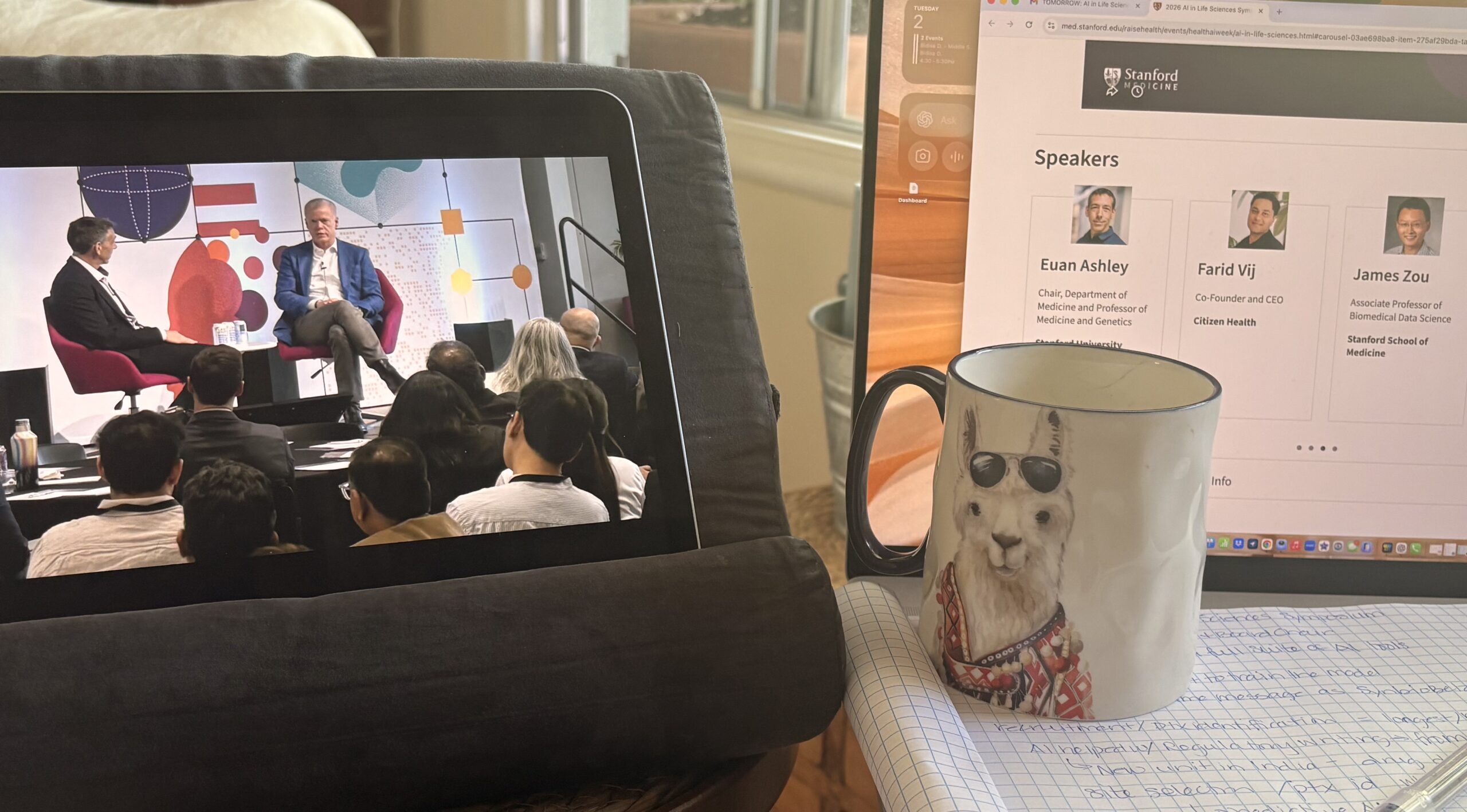
Biomedical research and clinical healthcare applications are excellent examples of the beneficial and responsible use of both predictive and generative AI. And the results are astounding. At conferences such as SynbioBeta and the Stanford AI in Health Science and Artificial Intelligence in Medicine and Imaging (AIMI) symposia, scientists are sharing remarkable AI-driven discoveries. James Zou’s lab at Stanford has created suites of thousands of agents to generate a Virtual Lab (2025), and has followed up by creating an entire virtual BioTech company (2026). The Virtual Lab agents designed a nanobody, which was tested in the wet lab (humans!) and outperformed the previous gold standard. Christopher Boerner, CEO of Bristol Myers Squibb, recently explained that every level of BMS has some form of AI integration and that they are investing heavily to expand its use. From the smallest academic labs to the largest pharmaceutical companies and in every local doctor’s office and hospital, all forms of AI are being adopted and used successfully.
Education Is Falling Behind
And then there’s science education; woefully underutilizing the array of AI tools leaving high school and undergraduate college students unprepared and underskilled for AI applications. The contrast could not be starker; it gives you whiplash! Too many students are still using AI as a shortcut or as a glorified Internet search engine. This couldn’t be further from how science and medicine actually use AI, and neither approach will prepare students for that future. And while innumerable certificates are offered across every aspect of AI application, they are no substitute for the experience of using and developing AI. So the discussion is not whether we should use AI in education; the question is how do we better prepare students for a fully AI-augmented future.
Why This Is Actually Good News for Students
Despite the rapid advances in AI, one message that emerges clearly and strongly from biomedical scientists, physicians, and industry leaders is the need for more data. Not just any data, highly specialized sets of data, generated by highly trained scientists. This is good news for students. Kimberly Powell, VP of Healthcare at Nvidia, says that the “AI scientist is here” and they will unlock what is already out there, but she emphasizes that we need significantly more work done in wet labs and will “forevermore.” And data generation is not the only human-driven aspect in high demand; research and medical applications of AI are driven and governed at the human level. Science needs thinkers. This is excellent news for your child! It represents a tremendous opportunity. Students who can think like scientists, critically, objectively, deeply, will be in tremendous demand. They will be the ones to direct and validate AI discovery.
The Skill That Matters Most
Most educational institutions are not adequately preparing students to understand AI governance or how to think critically about AI-generated information. By focusing on the trivial use of chatbots and failing to help students understand and explore AI, students are already underprepared for the future that awaits them. However, the answer is not to have your child jump into AI classes and do a panicked AI project. The first step to success with AI is thinking critically and deeply. There are innumerable examples of poorly developed predictive AI models, trained on the wrong datasets, that make biased and often harmful predictions. The common phrase “garbage in, garbage out” applies aptly to AI applications. And here is where my greatest concern about AI comes in: that we will not have enough high-quality thinkers to know the difference and recognize the garbage. Today’s fact- and memorization-based learning will not produce the quality scientists and physicians who can adequately assess data quality and guide AI to avoid harm.
What Does This Mean for Your Child
So what does all this mean for your child? The place to start is not with getting better at prompting AI or amassing AI certificates. It starts with learning how to think critically, understand data, evaluate evidence, and recognize errors in the process. Then, applying this knowledge to the use and development of AI tools. These combined skills will help ensure that your child becomes AI-literate and can govern AI responsibly. They will emerge as students prepared for the future of science and medicine.

Dr. Tobi Schmidt, PhD
Scientist | Mentor | Founder, Bio:Logic
Dr. Tobi Schmidt is a Stanford-trained scientist, mentor, and founder of Bio:Logic, a science mentorship consultancy for students pursuing biology, research, medicine, and the future of the biosciences. Her work focuses on developing scientific thinking, research skills, and AI literacy for the next generation of scientists.
REFERENCES AND SOURCES:
Swanson, Kyle et al. “The Virtual Lab of AI agents designs new SARS-CoV-2 nanobodies.” Nature vol. 646,8085 (2025): 716-723. doi:10.1038/s41586-025-09442-9
Zhang, Harrison G et al. “The Virtual Biotech: A Multi-Agent AI Framework for Therapeutic Discovery and Development.” bioRxiv : the preprint server for biology 2026.02.23.707551. 23 Feb. 2026, doi:10.64898/2026.02.23.707551. Preprint.
Powell, Kimberly (VP Healthcare, Nvidia) and Regev, Aviv (Executive Vice President, Genentech Research and Early Development). “Accelerating Discovery in Cancer.” Panel discussion presented at the AI in Life Science Symposium, Stanford University School of Medicine, Stanford, CA, June 2, 2026.
Boerner, Christopher (CEO, Bristol Myers Squibb). Remarks on AI integration at Bristol Myers Squibb. Keynote Speaker at the AI in Life Science Symposium, Stanford University School of Medicine, Stanford, CA, June 2, 2026.